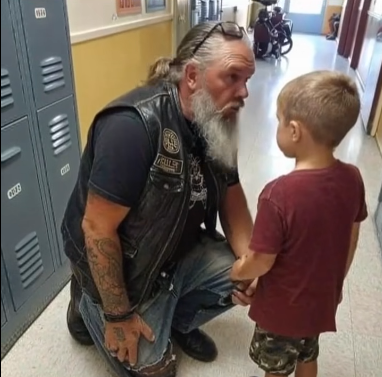
It happened on one of those easily forgotten afternoons — the kind that blend into the background of life. I was walking into my son’s school courtyard when I saw something that stopped me in my tracks: a large man with tattoos and a leather vest kneeling beside my eight-year-old. He was speaking quietly, pointing at a book open on the ground. My pulse spiked immediately. Every protective instinct in me kicked in. I didn’t pause to think — I just acted.
I rushed over, told my son to come with me, and later that day, I called the school to report what I had seen. The staff, equally alarmed, acted quickly. They told the man — a volunteer, I assumed — not to return.
At that moment, I felt like I had done the right thing. I was protecting my child. But that night, when my son came home, the truth hit me harder than I was prepared for. He dropped his backpack, his small face crumpling as tears filled his eyes.
“Mom,” he said between sobs, “why did you tell Mr. Ray he can’t come anymore?”
I blinked, confused. “Who’s Mr. Ray?”
“The man with the tattoos,” he said. “He helps me read.”
It was as if the air left the room. My son has dyslexia — something we’d been struggling with for years. He had always been bright and curious, but reading had destroyed his confidence. I had seen him hide books, change the subject when his classmates talked about stories they loved. And this stranger — this man I had judged by appearance — had been the one to reach him.
He explained, in broken sentences, that Mr. Ray had been coming to the school twice a week as a reading mentor. He understood how hard it was because he had dyslexia too. “He said he used to think he was stupid,” my son whispered, “but he wasn’t. He just needed someone to show him a different way.”
I didn’t sleep that night. The shame was relentless — realizing that I had let fear, stereotypes, and assumptions override empathy. I had seen tattoos and a leather vest and assumed danger. What I hadn’t seen was the humanity behind them.
The next morning, I called the school, apologized, and asked for his contact information. They hesitated — understandably — but eventually, I got a number. My hands shook as I dialed.
He answered after a few rings, his voice calm but cautious.
“Mr. Ray?” I began, my throat tight. “This is Daniel’s mom. I think I owe you an apology.”
There was a pause, then a quiet chuckle. “You don’t owe me anything,” he said. “You were just looking out for your kid. Any good parent would have.”
That humility, that grace, only made my guilt worse. I told him how much my son had missed him, how I hadn’t realized what he meant to him. Then I asked the question that felt too fragile to voice: “Would you… be willing to keep helping him? I can be there too, if you prefer.”
He agreed without hesitation.
So the next Saturday, we met at the public library. Mr. Ray arrived early, carrying a worn notebook and a stack of children’s books under his arm. The librarian smiled as he waved — clearly, this wasn’t his first time there. He greeted my son with an easy grin, crouching to his level. “Hey, champ. Ready to show me what you got?”
What I saw over the next hour humbled me.
Mr. Ray wasn’t just teaching reading — he was teaching resilience. When my son stumbled over words, he didn’t correct him harshly. He guided him gently, breaking down sounds, using rhythm, humor, and even stories about his own mistakes. “Letters used to dance for me,” he said with a laugh. “Still do sometimes. But you learn to dance with them.”
Week after week, we met at that same corner table. I watched my son’s frustration fade, replaced by confidence I hadn’t seen before. His teachers noticed too — improved test scores, a newfound eagerness to read aloud. But the biggest change wasn’t academic. It was emotional. He believed in himself again.
And Mr. Ray? He never asked for anything in return. No praise, no recognition. Just the quiet satisfaction of seeing a child light up when he finally read a sentence without stumbling.
One afternoon, I told him, “You’ve done more for my son than I could ever repay.”
He smiled. “You already did — you called me back. Most people wouldn’t have.”
That hit me hard. Because he was right. Most people wouldn’t have. Most people see a man covered in tattoos and assume trouble. But behind every scar, every inked story, there’s a life we don’t know — a story we never thought to ask about.
Months later, when the school held a literacy event, my son stood on stage and read an entire short story aloud. He looked at Mr. Ray in the crowd, and when he finished, he ran straight to him instead of me. Mr. Ray knelt, hugged him, and whispered something I couldn’t hear — but I didn’t need to. I saw it on my son’s face: pride, joy, and unshakable belief that he was capable.
That night, after the applause faded and the chairs were stacked, I thanked Mr. Ray again. He shrugged with his usual ease, then said something that stuck with me: “People look at me and see what they’re scared of. But your kid — he just saw someone who understood.”
Driving home, I thought about how quickly we categorize people, how instinct can blur into prejudice. I had almost robbed my son of the one person who could reach him — because I let fear win for a moment.
Now, when I see someone who looks “different,” I remind myself of that day. Of Mr. Ray’s patience, his kindness, his steady belief that brokenness doesn’t mean weakness.
My son still meets him at the library. He reads fluently now — above grade level. Sometimes, I catch him helping other kids sound out words, using the same gentle tone Mr. Ray once used with him.
It makes me smile every time.
Because now I know: the people who change our lives often don’t look the way we expect. Sometimes, they come wrapped in leather and ink, carrying books instead of warnings — and hearts big enough to teach the rest of us what humanity really looks like.


