In the fast-moving and ever-evolving landscape of social media, where billions of posts and images compete for our fleeting attention every day, it can be difficult to find content that truly captivates and engages us. Yet, amid this overwhelming digital noise, certain types of posts manage to stand out and momentarily capture the curiosity of millions. Among the most popular and widely shared are playful “personality tests” and optical illusions. These simple yet clever visual puzzles do more than just entertain—they invite us to pause, reflect, and engage with our own minds in a way that many other posts do not.
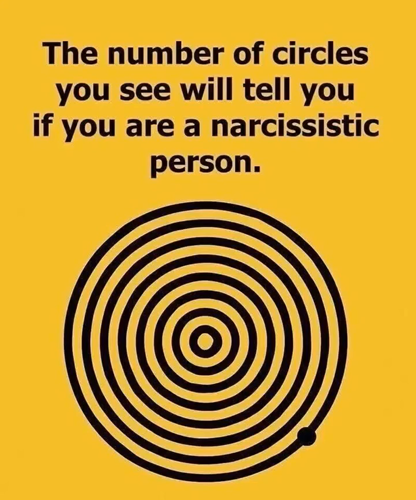
One particularly viral example is an intriguing image composed of overlapping circles, accompanied by a provocative statement that reads: “The number of circles you see reveals something about your personality.” This brief but bold claim has sparked widespread interest, prompting people all over the world to stop scrolling and focus their attention on a seemingly simple image.
When individuals first encounter this image, their reactions vary widely. Some people instinctively start counting the circles they believe they see, carefully analyzing the pattern and trying to discern every shape within the complex arrangement. Others might immediately tag friends, family members, or coworkers, eager to compare their observations and spark a lively conversation. This dynamic interaction often unfolds in the comment sections of social media platforms, where hundreds, sometimes thousands, of users share their results, theories, and even playful debates about what the image means.
What appears to be a straightforward visual puzzle actually touches on a deeper and universal human fascination: the desire to better understand ourselves, how our minds work, and the different ways in which each person perceives the world around them. The image itself is a masterclass in optical illusion design. At first glance, many viewers report seeing a swirling spiral or a continuous, twisting shape that seems to move or rotate as their eyes scan across it. This mesmerizing effect is a common characteristic of well-crafted illusions, which exploit the brain’s natural tendencies and assumptions to create a perception that doesn’t fully align with reality.
Upon closer examination, however, the truth reveals itself: the image is composed of several distinct circles carefully arranged to produce the illusion of a spiral. This subtle distinction is crucial, as it highlights how easily our brains can be tricked by visual stimuli—and how much interpretation is involved in even the simplest acts of seeing. Interestingly, the number of circles that a person perceives can vary dramatically. Some individuals are able to quickly and accurately identify all the circles, while others might see only a few or none at all.
This variation does not imply any deficiency or superiority; rather, it reflects the unique way each person’s eyes and brain work together to process visual information. Factors such as attention to detail, visual acuity, previous experience with illusions, and even mood or focus at the moment can influence what someone sees. In this way, the image becomes a subtle mirror of the individual viewer’s cognitive and perceptual style, offering a glimpse into the fascinating complexity of human perception.
What makes these viral tests so compelling and widespread is not their ability to categorize or diagnose, but their power to engage us in lighthearted self-exploration and social connection. Unlike formal psychological assessments, these illusions and “tests” are less about creating rigid labels and more about fostering curiosity, conversation, and a shared sense of wonder. They remind us that human perception is wonderfully diverse and that a single image can be interpreted in countless ways, depending on the viewer’s unique perspective.
This diversity of perception is a beautiful reminder of the complexity and richness of human experience, where no two people see the world in exactly the same way. Beyond the immediate fun and fascination, these illusions carry a deeper philosophical message about the nature of reality and how it is shaped by our minds. They challenge us to question the reliability of our senses and to appreciate the subjective nature of experience. What we perceive is not always an objective truth but a construct shaped by biology, psychology, and context. This awareness can encourage empathy and understanding, reminding us that others may genuinely experience the same world differently—and that difference is not only natural but valuable.
So next time you encounter an optical illusion or a viral “personality test” on your feed, don’t just scroll past. Take a moment to truly engage with it. Count the circles or shapes you see, share your findings with others, and enjoy the discussions that arise from your varied perceptions. These simple interactions reveal much about the fascinating ways our minds work and connect us to a larger community of curious, thoughtful individuals. Ultimately, optical illusions serve as playful yet profound reminders that perception is deeply personal, endlessly variable, and endlessly worth exploring. They encourage us to embrace both the mystery and the beauty of the human mind’s ability to create meaning from the world around us.
In the fast-moving and ever-evolving landscape of social media, where billions of posts and images compete for our fleeting attention every day, it can be difficult to find content that truly captivates and engages us. Yet, amid this overwhelming digital noise, certain types of posts manage to stand out and momentarily capture the curiosity of millions. Among the most popular and widely shared are playful “personality tests” and optical illusions. These simple yet clever visual puzzles do more than just entertain—they invite us to pause, reflect, and engage with our own minds in a way that many other posts do not.
One particularly viral example is an intriguing image composed of overlapping circles, accompanied by a provocative statement that reads: “The number of circles you see reveals something about your personality.” This brief but bold claim has sparked widespread interest, prompting people all over the world to stop scrolling and focus their attention on a seemingly simple image.
When individuals first encounter this image, their reactions vary widely. Some people instinctively start counting the circles they believe they see, carefully analyzing the pattern and trying to discern every shape within the complex arrangement. Others might immediately tag friends, family members, or coworkers, eager to compare their observations and spark a lively conversation. This dynamic interaction often unfolds in the comment sections of social media platforms, where hundreds, sometimes thousands, of users share their results, theories, and even playful debates about what the image means.
What appears to be a straightforward visual puzzle actually touches on a deeper and universal human fascination: the desire to better understand ourselves, how our minds work, and the different ways in which each person perceives the world around them. The image itself is a masterclass in optical illusion design. At first glance, many viewers report seeing a swirling spiral or a continuous, twisting shape that seems to move or rotate as their eyes scan across it. This mesmerizing effect is a common characteristic of well-crafted illusions, which exploit the brain’s natural tendencies and assumptions to create a perception that doesn’t fully align with reality.
Upon closer examination, however, the truth reveals itself: the image is composed of several distinct circles carefully arranged to produce the illusion of a spiral. This subtle distinction is crucial, as it highlights how easily our brains can be tricked by visual stimuli—and how much interpretation is involved in even the simplest acts of seeing. Interestingly, the number of circles that a person perceives can vary dramatically. Some individuals are able to quickly and accurately identify all the circles, while others might see only a few or none at all.
This variation does not imply any deficiency or superiority; rather, it reflects the unique way each person’s eyes and brain work together to process visual information. Factors such as attention to detail, visual acuity, previous experience with illusions, and even mood or focus at the moment can influence what someone sees. In this way, the image becomes a subtle mirror of the individual viewer’s cognitive and perceptual style, offering a glimpse into the fascinating complexity of human perception.
What makes these viral tests so compelling and widespread is not their ability to categorize or diagnose, but their power to engage us in lighthearted self-exploration and social connection. Unlike formal psychological assessments, these illusions and “tests” are less about creating rigid labels and more about fostering curiosity, conversation, and a shared sense of wonder. They remind us that human perception is wonderfully diverse and that a single image can be interpreted in countless ways, depending on the viewer’s unique perspective.
This diversity of perception is a beautiful reminder of the complexity and richness of human experience, where no two people see the world in exactly the same way. Beyond the immediate fun and fascination, these illusions carry a deeper philosophical message about the nature of reality and how it is shaped by our minds. They challenge us to question the reliability of our senses and to appreciate the subjective nature of experience. What we perceive is not always an objective truth but a construct shaped by biology, psychology, and context. This awareness can encourage empathy and understanding, reminding us that others may genuinely experience the same world differently—and that difference is not only natural but valuable.
So next time you encounter an optical illusion or a viral “personality test” on your feed, don’t just scroll past. Take a moment to truly engage with it. Count the circles or shapes you see, share your findings with others, and enjoy the discussions that arise from your varied perceptions. These simple interactions reveal much about the fascinating ways our minds work and connect us to a larger community of curious, thoughtful individuals. Ultimately, optical illusions serve as playful yet profound reminders that perception is deeply personal, endlessly variable, and endlessly worth exploring. They encourage us to embrace both the mystery and the beauty of the human mind’s ability to create meaning from the world around us.


